
As NIS 2 raises the bar across Europe, organizations operating in Belgium are taking a closer look at CyberFundamentals (CyFun) as a practical national framework for structuring cyber resilience efforts. For enterprises with operations in Belgium, CyFun gives teams a concrete way to structure security expectations and show progress over time.
The problem is that most CyFun programs are still driven by static spreadsheets, email threads, and one-off self-assessments. That model doesn’t scale for complex environments, multiple frameworks, and lean security teams.
Drata’s CyberFundamentals support is designed to change that.
The Challenge: CyberFundamentals Without More Overhead
CyFun, owned by the Centre for Cybersecurity Belgium (CCB), is a framework that offers a clear, step-by-step approach to help organisations protect their data, significantly reduce their risk of common cyber-attacks, and improve cyber resilience. It uses a proportional assurance model with three assurance levels, Basic, Important, and Essential, preceded by an entry level called Small.
For enterprises, especially those already running ISO 27001, NIST CSF, SOC 2, or CIS Controls, CyFun introduces several challenges:
- Duplicated work across frameworks. Teams struggle to understand how CyFun maps to existing ISO/NIST programs, leading to parallel implementations and redundant evidence collection.
- No single view of CyFun coverage. Maturity assessments live in spreadsheets and slide decks, not in an operational system of record with real-time control status.
- Limited visibility for leadership. Boards, CISOs, and regulators expect proof of annual progress and continuous improvement, not one-off self-assessments that go stale quickly.
- Pressure from broader European cyber resilience obligations. CyFun is not a legal requirement, but the 2025 update does introduce an important key measure on sharing cybersecurity incidents with relevant external stakeholders and reporting significant incidents to authorities as required by law. .
For GRC leaders and CISOs, the ask is clear: operationalize CyFun as part of your broader program, without creating another siloed project or tool stack.
The Solution: Operationalizing CyberFundamentals in Drata
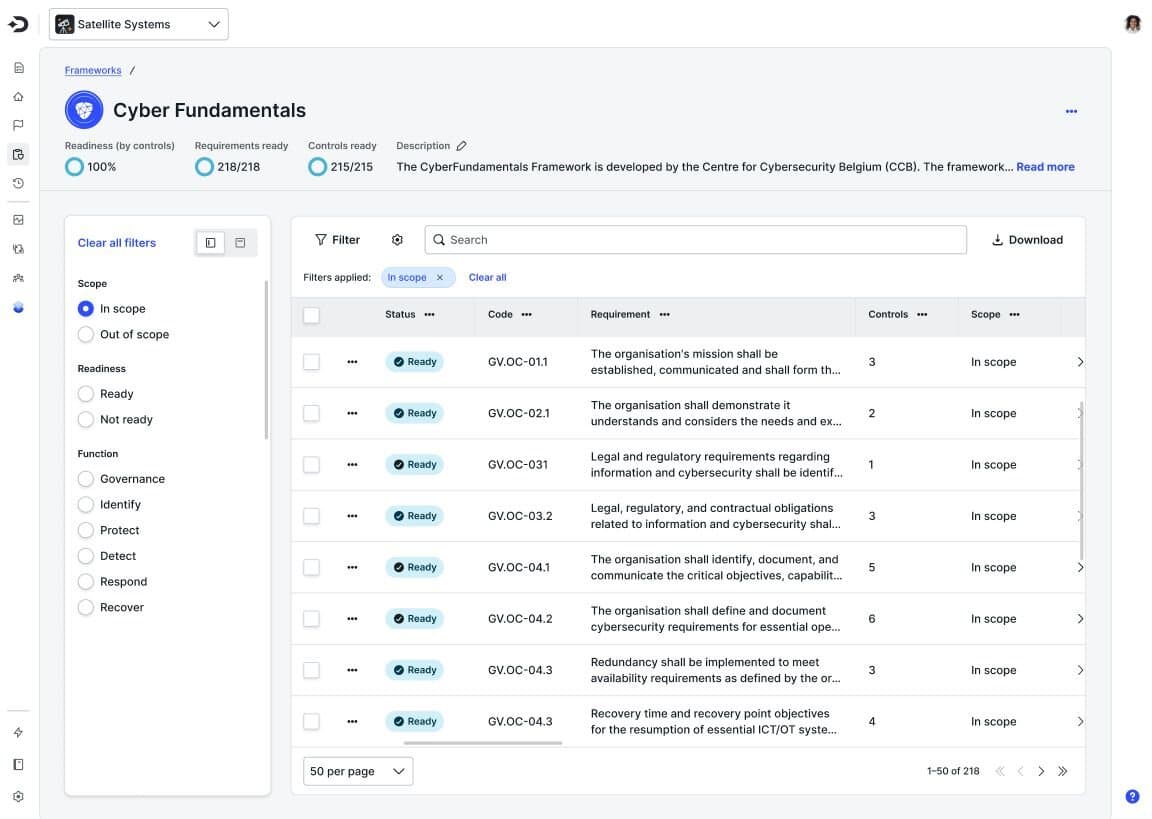
Drata operationalizes the CyberFundamentals framework with continuous monitoring, automated workflows, and integrated risk, so organizations can align with CyFun and NIS 2 expectations without adding headcount or more spreadsheets.
CyFun is available as a dedicated framework within Drata, with:
- Requirements mapped to Drata Common Controls (DCF) so you can implement a control once and reuse evidence across CyFun, ISO 27001, NIST CSF, SOC 2, and more.
- Tailored policy templates covering areas CyFun expects—such as acceptable use, asset management, backups, incident response, encryption, physical security, access control, and vendor management—managed centrally in Policy Center.
- Continuous control monitoring via integrations and automated tests, replacing static self-assessment checklists with a live control map.
Because CyFun is supported by relevant insights from the NIST Cybersecurity Framework, ISO 27001/ISO 27002, IEC 62443, and the CIS Critical Security Controls, Drata helps teams align CyFun work with broader security and compliance efforts without creating a separate operating silo.
Use Cases by Persona
Director / Head of GRC or Compliance
For champions responsible for overall governance, Drata provides a single view of CyFun controls, tasks, and evidence across all three assurance levels. You can map CyFun to your existing ISO and NIST controls, track recurring activities (like vulnerability scans, access reviews, and backup tests), and show boards and regulators a defensible improvement story year over year.
CISO / VP Security
Security leaders gain continuous visibility into CyFun safeguards—such as MFA, backups, logging, antivirus, segmentation, and risk management—through Drata’s monitoring, Risk Management, and Vulnerability Monitoring capabilities. This makes it easier to demonstrate a structured, risk-based CyFun program while supporting broader cyber resilience efforts without ballooning assurance headcount.
Security Engineers and IT Admins
Practitioners responsible for implementing CyFun key measures can orchestrate patching, backups, VPN/MFA deployment, endpoint protection, logging, and awareness training using Drata’s integrations, automated tests, and Task Management. Evidence is captured once and reused across frameworks and questionnaires instead of being rebuilt for each review.
Third-Party Risk Teams
Third-Party Risk Teams can leverage agentic workflows to assess suppliers against CyFun’s supply chain-related standards and tie their third-party posture back to the same CyFun-aligned view of risk and controls.
The Impact: From Static Self-Assessments to Continuous CyberFundamentals Readiness
Enterprises using Drata for CyberFundamentals realize four key outcomes:
- Continuous CyFun readiness
Move beyond annual CyFun self-assessment checklists to a live control map with automated testing, so teams always know where they stand across CyFun Basic, Important, and Essential levels. - Single implementation for multiple frameworks
Implement a control once in Drata and reuse evidence across CyFun, ISO 27001, NIST CSF, SOC 2, and more—eliminating redundant projects and spreadsheets. - Automated cyber hygiene at scale
Use Drata’s integrations, tests, and workflows to automate evidence collection and reminders for CyFun’s low-cost, high-impact safeguards, such as MFA, backups, patching, logging, and awareness training. - Provable, shareable assurance
Publish your CyFun-aligned posture via Drata Trust Center and use AI Questionnaire Assistance to auto-draft responses to CyFun- and NIS 2–related questionnaires using existing evidence—shortening procurement and review cycles.
Why It Matters for Complex Environments
For enterprises with Belgian operations, CyFun is explicitly aligned with ISO and NIST and is intended as a practical baseline and bridge—not a competing ISMS. Drata’s approach turns that baseline into an advantage:
- Continuous vs. periodic. CyFun is often implemented as an annual self-assessment; Drata makes CyFun continuous, monitored, and evidenced.
- Unified vs. siloed. Generic GRC or local tools often require separate projects for CyFun, ISO, and NIST; Drata unifies frameworks and evidence in one platform so teams work from a single source of truth.
- Agentic, AI-native automation. Drata’s AI and workflow engine reduce manual work across evidence collection, risk, and questionnaires—critical for the lean teams CyFun was designed to support.
- Trust as a business accelerator. By combining continuous monitoring with a public-facing Trust Center, CyFun alignment becomes something you can demonstrate to customers, partners, insurers, and regulators—not just claim in a slide deck.
See CyberFundamentals in Drata
CyberFundamentals is already available as a framework in Drata, with requirements, DCF control mappings, and policy templates, supported by the same Continuous Compliance, Integrated Risk Management, Policy Center, Trust Center, and AI Questionnaire Assistance capabilities you use today.
If you’re responsible for CyFun alignment and broader cyber resilience readiness in Belgium, now is the time to move from static assessments to continuous assurance.
Request a demo to see how CyberFundamentals fits into your broader compliance and risk program, and how you can operationalize it without adding another tool or team.