
The CRA or Cyber Resilience Act (Regulation (EU) 2024/2847) gives manufacturers of hardware and software products a clear, EU-wide standard for building security best practices into products from the start and maintaining them effectively. As a Regulation, it applies automatically across every EU country, with no country-by-country rollout to track. Its reporting obligations took effect September 11, 2026, and its broader requirements — covering secure-by-design development, vulnerability handling, documentation, and conformity assessment — become fully applicable December 11, 2027.
That timeline still leaves a real runway. Reporting obligations already live, so the work ahead is the bigger lift:secure-by-design development, documentation, and conformity assessment before the December deadline.Teams that start now can build that foundation properly instead of assembling it under pressure. The challenge is knowing where the work tends to stall.
Where Most Teams Get Stuck
If your company sells hardware, software, IoT devices, or anything else with a chip or code in it into the EU, there's a good chance the CRA applies to you — with narrow carve-outs for pure SaaS, medical devices, vehicles, aviation and marine equipment, and a handful of other sector-specific exclusions. For most teams, the hard part isn't understanding applicability — it's finding one place to manage it well.
Knowing which products are in scope, whether they're built securely, and whether documentation would satisfy a regulator's review is work that often lives across spreadsheets, legal memos, and disconnected tools. The CRA also introduces a staged reporting rhythm: manufacturers have 24 hours from becoming aware of an actively exploited vulnerability or a severe incident to file an early warning, 72 hours to follow up with more detail, and then a final report — due within 14 days of a fix for vulnerabilities, or within one month of the initial notification for incidents. Having that workflow in place before an incident happens is what makes the timelines manageable.
Manufacturers also need visibility into the security of the components they integrate. That makes CRA readiness a natural reason to extend product-security practices to suppliers and open-source dependencies teams already rely on. That's the gap a purpose-built CRA framework is meant to close.
Turning CRA Into a Repeatable System
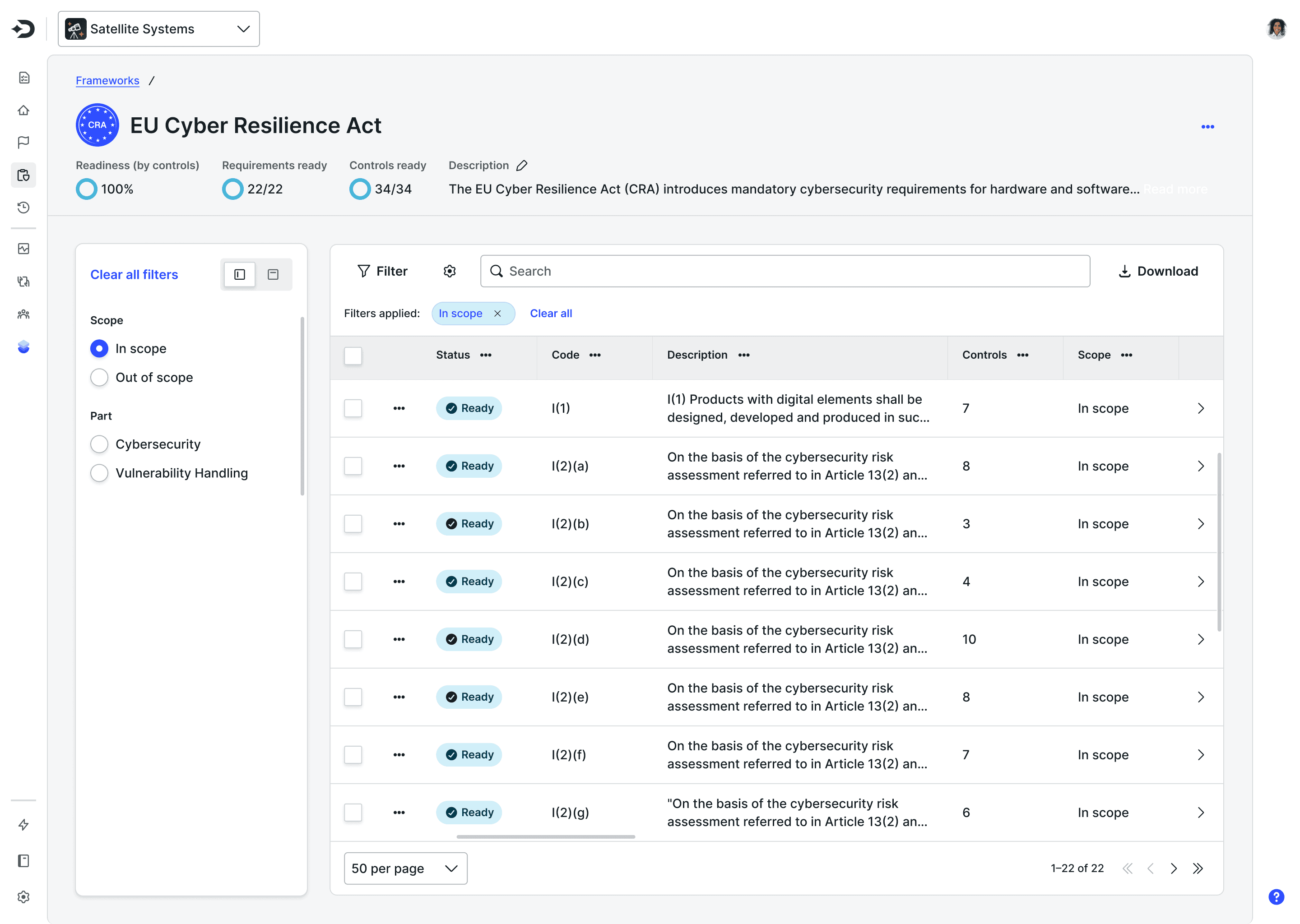
Drata now supports a focused CRA framework covering the 22 Essential Cybersecurity Requirements in Annex I. A Requirements Library breaks the regulation into practical requirements for self-assessment and third-party review, so teams can start from a clear structure instead of reverse-engineering the law themselves. Those requirements map to Drata Common Framework (DCF) controls for secure-by-design, vulnerability-handling, and lifecycle-security obligations — controls that are cross-mapped across frameworks, so evidence gathered once for CRA can also count toward overlapping requirements elsewhere.
From there, Continuous Control Monitoring keeps those controls checked on an ongoing basis rather than documented once and set aside, which fits the CRA's post-market model. Audit Hub centralizes the resulting supporting evidence, and Task Management tracks recurring work such as vulnerability remediation and evidence updates. Vulnerability Monitoring, tailored policy templates, and Drata's agentic Third-Party Risk Management (TPRM) for supplier and component risk round out the picture.
Taken collectively, Drata supports everyone the CRA touches.
What This Looks Like Day-to-Day
Directors of Compliance and GRC Managers get a single source of truth for which CRA obligations apply, mapped controls, and readiness activities.
CISOs and VPs of Security clearly define operations around the CRA's reporting clock: identifying, triaging, documenting, and escalating vulnerabilities and severe incidents on the regulation's staged timelines.
Product and Engineering Leads get practical support for secure product development, vulnerability handling, and coordinating software bill of materials (SBOM) and related evidence with compliance and security teams.
Individually, that's less to track for each team. Together, it adds up to something bigger: fewer handoffs, one shared source of truth, faster response when an incident hits.
The Difference It Makes
With Drata, teams get a documented approach to the 22 Essential Cybersecurity Requirements in Annex I, centralized and continuously maintained supporting evidence including SBOM-related information, and cross-mapped controls that cut down on duplicate work across overlapping frameworks — all inside the platform teams already use for the rest of their compliance program.
That foundation is worth building well: The point is to show, clearly and continuously, that your products are secure by design.It’s a natural extension of good product security practice.
Why Now Is the Right Time
Most teams evaluating CRA readiness today are asking a simple question: when should I start? The answer is now. Because the CRA touches product security, documentation, and supply-chain risk all at once, a single system that connects those pieces is a better fit than a checklist bolted onto an existing program. That's the approach Drata's CRA framework is built around — and getting started with it is the easy part.
Get Ahead of the Deadline
The EU Cyber Resilience Act sets a clear bar for product security — and now there's one place to help you meet it. Get a demo to see how your team can move from scattered tracking to a single, continuously ready system.