
In today’s complex and rapidly evolving regulatory landscape, the term "workspaces" is frequently used but poorly defined. For global enterprises navigating multi-framework compliance, expanding into new markets, and adopting transformative technologies like AI, the architecture behind “workspaces” can determine whether compliance becomes a scalable advantage or an operational bottleneck.
Beneath this model, integrations to different applications act as the shared data plane—ingesting identity, HR, development, and infrastructure telemetry—so evidence and test results can be reused where appropriate and scoped where required across workspaces. This turns separation and sharing into a governed default rather than a manual exercise.
In this blog post I’ll redefine what an enterprise-class workspace should deliver—going beyond surface-level tagging or wholly siloed instances. I’ll highlight the essential traits of a well-architected workspace model: intelligent separation and sharing, seamless reuse of evidence, delegated ownership, and centralized visibility. In doing so, I’ll help organizations cut through the noise, assess their platform’s real capabilities, and identify architectures that support growth without compromising governance, audit integrity, or efficiency.
The Growing Complexity of Compliance
According to the PwC 2025 State of Compliance Report, 62% of enterprises manage more than three concurrent audits annually, and 48% report significant duplication of compliance efforts across business units. The ISACA 2024 Trends Report reinforces that 85% of compliance teams cite test automation and control inheritance as essential to scale effectively.
Yet, many platforms only approximate workspace functionality through naming conventions or tags—a workaround that may suffice for simple, single-audit SaaS firms but collapses under greater complexity. For example:
- GRC teams are managing an average of eight compliance frameworks with 60% managing at least five, adding an average of six more in the next 12 months (The State of GRC 2025 Report).
- Enterprises expanding into new regions—like EMEA or India—must integrate additional compliance layers (e.g., GDPR, AI Act, India’s DPDP), intensifying governance burdens.
- 52% of organizations operate multiple compliance tools due to segmentation issues, drawing from CSA analysis on fragmented compliance ecosystems.
- Manual GRC interventions consume an average of 14 hours per week, yet 93% of organizations still rely on partially or fully manual compliance processes.
Integrations: The Operational Backbone
A workspace model scales when the underlying data flows are standardized. Integrations normalize input from core systems (IdP, HRIS, code repositories, cloud platforms, ticketing) so the same underlying facts—configuration states, change histories, incidents—can populate controls and tests in multiple workspaces without duplicate collection. Where frameworks diverge, evidence remains traceable to its source and is linked to the right control in the right workspace, preserving isolation and audit clarity.
Why Workspaces Matter for Scalable Compliance
Organizations with multiple business units, product lines, or regulatory domains (e.g., civilian and government frameworks):
- Require logical segmentation for audit readiness, regional needs, and governance control.
- Need choice of wholly isolated instances as well as workspaces that support a blend of some synced and some unsynced data and objects as defined by the org.
- Must share common controls or evidence across teams (e.g., universal asset management, company-wide policies).
- Need central visibility to assess compliance posture holistically in dashboards spanning all units.
- Demand flexibility to manage a mix of frameworks—such as ISO, HIPAA, FedRAMP, or PCI—for diverse global and internal standards.
The negative impact of not having functional workspaces is significant. Without them, organizations cannot easily expand support for new products, business units, or regions. This gap also generates an exponential amount of manual effort in duplicating and tracking controls and related evidence as organizations grow.
Not only does this place a greater burden on security and GRC teams, it blocks new business opportunities and slows revenue growth. Real buyer experiences spoke to other consistent pain points:
Duplicated Controls & Evidence
When frameworks or controls cannot be shared across environments, teams are forced to rebuild identical components across each product, region, or audit—creating massive duplication.
“We had to rebuild the same control in five places.” — HealthTech Compliance Buyer
Lack of Test Inheritance
Without test inheritance, teams must execute and document the same test procedures multiple times, even for universal controls like access reviews or encryption policies.
“We couldn’t reuse tests across frameworks—everything had to be manual.” — Cloud CRM Platform
No Isolation by Entity
Tag-based systems don’t enforce separation by business unit, increasing the risk of data bleed and unauthorized access across sensitive audit boundaries.
“We needed to separate ownership by business unit—there was no way to enforce boundaries.” — Fintech Security Team
Manual Workspace Configuration
Systems that require one-by-one configuration of controls, policies, and evidence waste time and introduce inconsistency across teams.
“Every workspace setup—users, evidence, integrations—had to be done from scratch.” — Cybersecurity Operations Org
What Defines an Enterprise-Class Workspace Architecture
A properly architected compliance workspace model isn’t just about segmentation, it’s about structured governance, operational clarity, and the ability to scale with confidence. The most effective models are designed for real-world complexity: multi-framework environments, global operations, and distributed accountability. They deliver not only technical separation, but also the connective tissue that unifies evidence, tests, roles, and visibility.
Key Architectural Characteristics
These elements form the foundation of a workspace model built for scale and audit reliability:
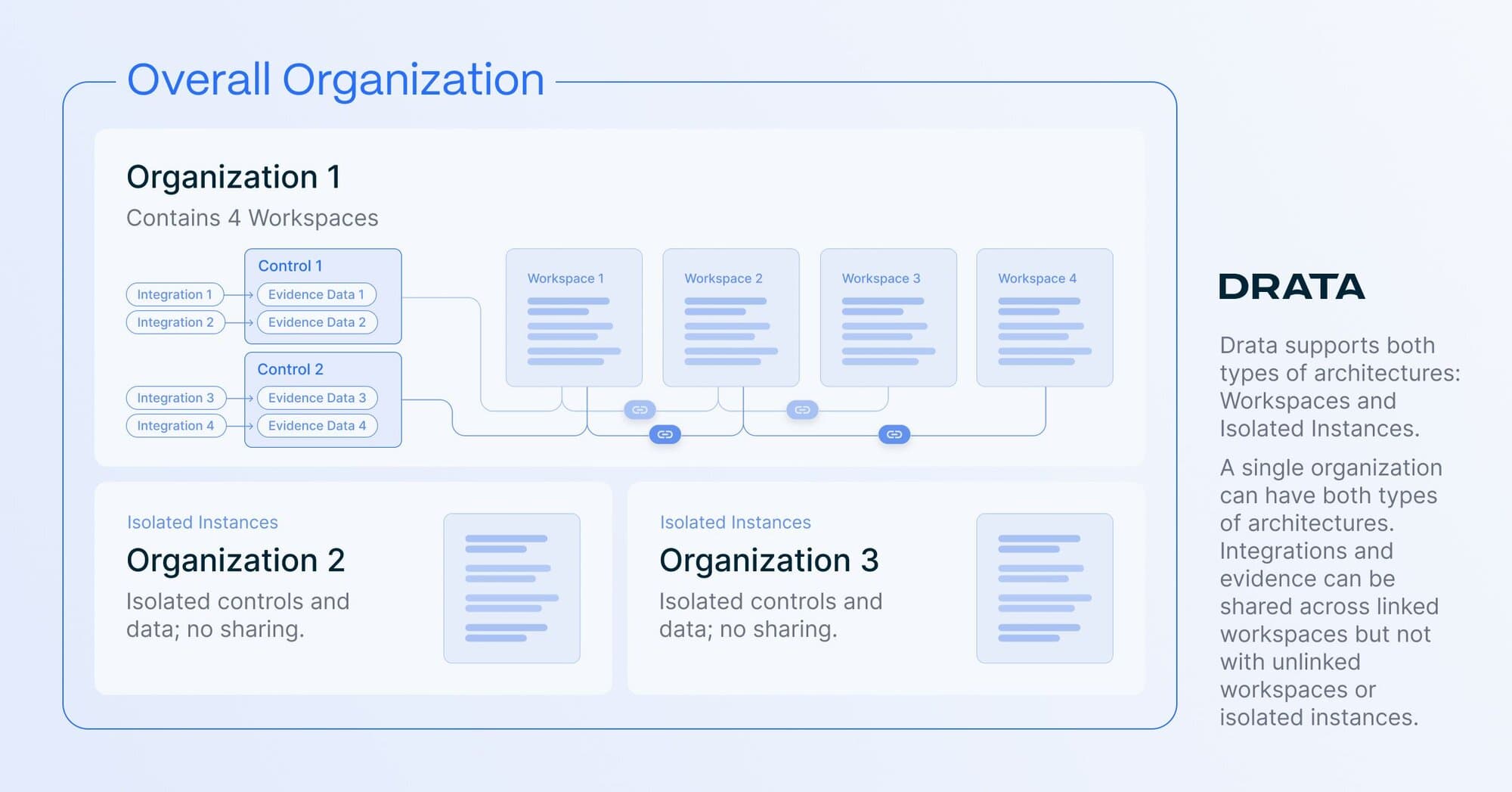
- Flexible Workspace-Level or Multi-Instance Isolation Every product line, region, or business unit can operate in a distinct, fully segmented compliance instance or a nuanced combination of linked and unlinked controls and evidence across workspaces.
- Cross-Workspace Linking Controls and evidence can be linked across workspaces where appropriate, reducing duplication and streamlining compliance.
- Integration‑Aware Reuse Evidence gathered through integrations should not be trapped in a single context. The platform should allow teams to link a single piece of evidence to the same control across multiple workspaces, with updates reflected everywhere it is linked. This removes parallel uploads while maintaining workspace‑level scope and ownership.
- Integrations as a Shared Data Plane An integration layer should both automate checks (e.g., cloud hardening, identity hygiene, ticket lifecycles) and provide workspace‑specific tests based on enabled frameworks. Controls, tests, and permissions remain workspace‑scoped for governance; the underlying evidence can be reused wherever the same control exists.
- Delegated Ownership Controls and evidence can be assigned and managed by workspace, ensuring accountability without operational overlap.
- Central Governance and Readiness Rollups A unified dashboard allows leaders to track audit readiness and control performance across all workspaces from a single vantage point.
- Event and Test Visibility System events, test results, and alerts can be filtered and acted upon at the workspace level—ensuring clear audit traceability.
Operational Indicators of Scale in Practice
When this architecture is implemented correctly, it produces measurable business and compliance benefits:
- Efficiency Ingest once through integrations; link once to the same control across workspaces—eliminating rebuild and re‑upload cycles.
- Scalability As new workspaces come online, required integrations are in place, tests are available as soon as relevant frameworks/controls are enabled— no bespoke wiring necessary. Multiple workspaces can be managed without friction, mapped to each new business unit, region, or framework.
- Audit Integrity and Visibility Consolidated views and scoped ownership ensure no control or finding slips through the cracks across distributed teams.
- Team Collaboration Clearly linked evidence empowers global teams to work independently yet in alignment.
- Automation Frameworks, tests, and alerts can be deployed consistently across all workspaces with minimal manual effort.
Together, these capabilities define not just a better user experience—but a more resilient, audit-ready, and enterprise-aligned compliance infrastructure.
Validated Outcomes with Drata
Drata’s enterprise-grade workspace architecture isn’t just conceptually stronger. It drives measurable, real-world outcomes for complex organizations. Customers migrating from legacy or simulated workspace systems consistently report major gains in efficiency, clarity, and audit readiness.
From synched controls to unified dashboards, Drata’s intelligently designed workspace enables scale without sacrificing structure. Across complex environments, organizations report that workspace segmentation paired with an integration‑led data plane reduces duplicate uploads, accelerates test readiness, and streamlines audit roll‑ups.
As some of our customers have reported:
“Now we can link controls across products without duplicating effort. It’s saved us weeks.” — Cloud Identity SaaS Buyer
“The ability to roll up dashboards across all our business units changed how our leadership views compliance.” — Enterprise Healthcare Platform
“We run 20+ audits a year, and Drata’s workspace model finally gave us a way to scale without chaos.” — Fintech Compliance Org
“Before Drata, we had five different versions of the same policy. Now it's one policy, scoped to all our workspaces.” — HR Tech Platform
Key Questions to Identify Robust Workspace Architecture
When evaluating a compliance platform's workspace capabilities, the first critical question is:
- Does the solution give organizations a choice of both the following scenarios?
- Scenario 1: A wholly isolated instance that does not share any data, and
- Scenario 2: A flexible workspace that can be customized to sync some controls and evidence but not sync others
Most sophisticated customers require both at some point. Moreover, important questions to ask solutions claiming to support scenario 2 include:
- Does evidence uploaded to one control automatically sync to all linked workspaces?
- Can controls and evidence be shared across workspaces without manual naming, tags, or duplication of evidence?
- How are integrations managed across multiple workspaces—once or per workspace?
- Does evidence need to be updated across each workspace? For every update?
- Can the platform accommodate multi-framework audits across business units without duplication of evidence or effort?
Questions asked also need to encompass integration design and evidence reuse; for instance:
- Are tests explicitly workspace‑scoped, and do they declare clear integration dependencies (e.g., cloud, IdP, ticketing) for when and where they run?
- Can one evidence artifact be linked to the same control across multiple workspaces—and do updates propagate to all linked instances?
- How is evidence lineage preserved (source system, timestamp, resource identifiers) when reused across workspaces?
- Is there centralized integration management (catalog, status, health) with workspace‑level controls over who can configure and consume those feeds?
- Can the platform accommodate custom or on-prem integrations and funnel them through the same evidence and testing model?
Conclusion: Developing Scalable, Flexible Workspaces at Your Organization
A workspace is more than just a label. It’s the foundation of scalable compliance governance. Organizations should look beyond marketing terms and closely evaluate the underlying architecture.
Platforms that offer both fully isolated, multi-instance environments, as well as customizable and synced workspaces are far better suited to meet the evolving needs of complex compliance environments. Asking the right questions is the first step to identifying a workspace model that reduces risk, saves time, and future-proofs your compliance strategy.