AI agents are already running inside your enterprise, and most security teams cannot say how many, who owns them, or what each one is allowed to do. Employees spin them up through software connectors. Engineers build them from internal frameworks. Vendors ship them silently inside products you already buy. The question of how companies govern agentic AI has moved from a future concern to a present gap, because boards, customers, and auditors have all started asking the same thing: how are your AI agents governed, and where is the proof?
This guide lays out a complete enterprise framework for answering that question. We will define what agentic AI governance is, why it differs from the AI governance you already practice, what to govern, and how to apply controls across the full agent lifecycle.
What Is Agentic AI Governance
Agentic AI governance is the structured management of delegated authority in autonomous AI systems that plan and execute actions on behalf of an organization. It sets clear boundaries on what agents can access and do at runtime, then holds someone accountable for the outcome.
Unlike traditional AI that generates an output for a human to act on, agentic AI acts on its own initiative. It makes decisions and completes multi-step tasks without a person approving each action. Governance, then, is no longer about validating a prediction. It is about controlling behavior in real time.
Three characteristics define the systems this framework governs:
- Autonomous decision-making: Agents choose actions without step-by-step human approval.
- Tool and system access: Agents connect to databases, application programming interfaces (APIs), and enterprise applications.
- Goal-oriented execution: Agents pursue an objective across many steps, adapting as they go.
Explore the Future of AI Agent Governance with Drata
Get hands-on with our limited availability platform, in development with select enterprises.
Why Agentic AI Governance Matters for Enterprises
AI agents are proliferating faster than governance programs can keep up. Delinea found that 44% of organizations have business units deploying AI without IT or security involvement. This is the new shadow IT, except agents do not sit idle waiting for someone to log in. They are already acting, reading data, calling APIs, and taking actions on permissions nobody scoped, at machine speed and often with no human in the loop.
The gap between “we think we have a few” and “we actually have hundreds” is exactly where the risk lives. The more agents you run, the larger your risk surface grows, and ungoverned agents carry real business consequences. Gartner predicts over 40% of agentic AI projects will be canceled by end of 2027 due to inadequate risk controls.
- Compliance penalties: Agents acting outside policy boundaries trigger audit failures and regulatory exposure.
- Security breaches: Unmonitored agents become attack vectors that operate without oversight.
- Reputational damage: Autonomous decisions that harm customers erode the trust your business depends on.
Roughly 90 percent of companies cannot answer how their AI agents are governed, and only about one in ten can prove an audit trail for AI agent decisions. That gap is the reason this matters now.
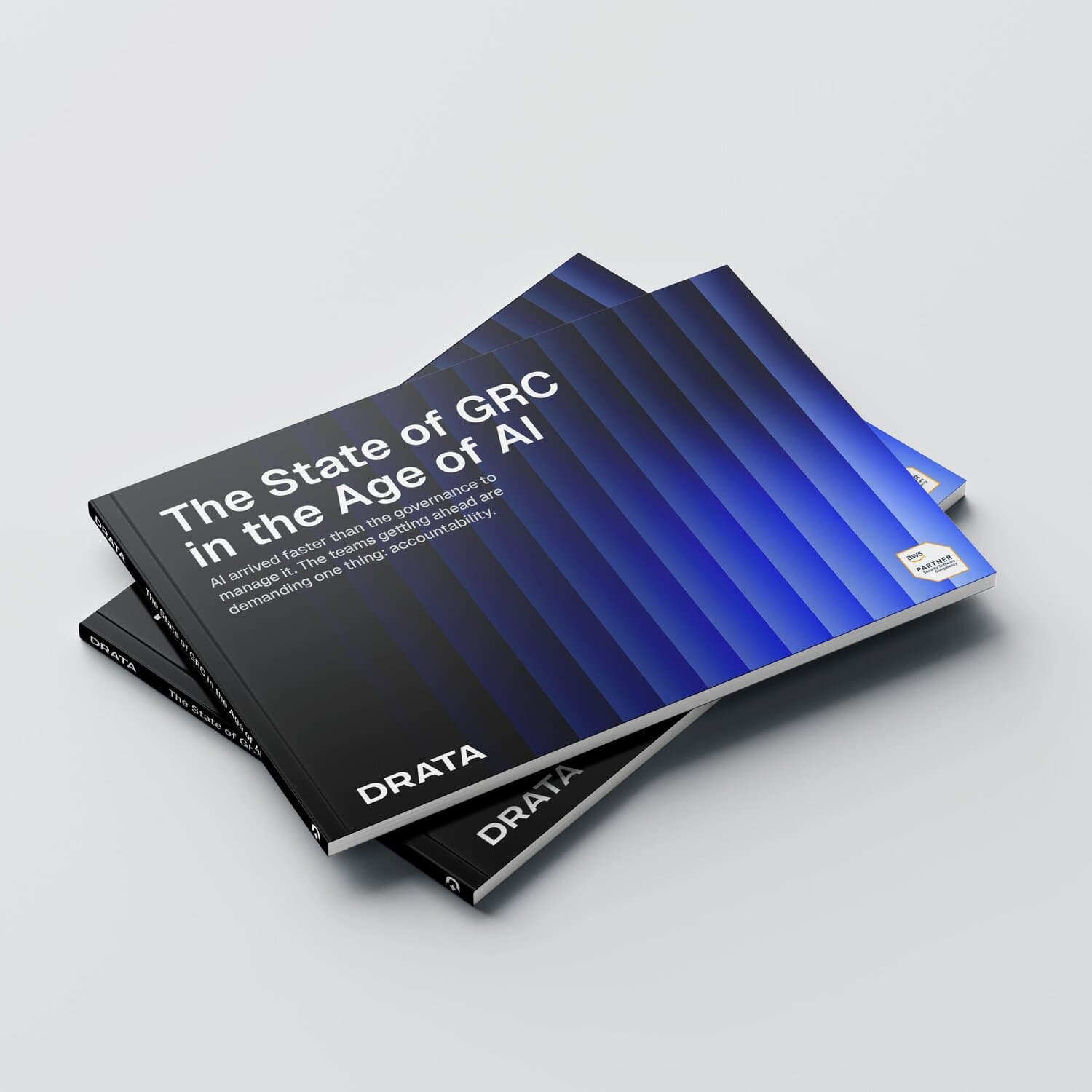
The State of GRC in the Age of AI
Only 13% of IT and security professionals are fully confident they can see every AI tool their teams use. Download The State of GRC in the Age of AI to see what 300 practitioners revealed about governing AI faster than it's outpacing them.
How Agentic AI Governance Differs from Traditional AI Governance
Traditional AI governance focuses on the model itself: accuracy, bias testing, and validating outputs before deployment. It asks, “What did the model predict?” Agentic governance asks a harder question: “What did the agent do?”
That shift changes everything about how you apply controls. Agents act continuously, invoke tools, and outlive the session that created them, so point-in-time review cannot keep pace. The table below maps the difference.
Governance Aspect | Traditional AI | Agentic AI |
Focus | Model outputs and predictions | Actions and decisions |
Timing | Pre-deployment validation | Continuous runtime monitoring |
Risk surface | Data and model bias | Access, permissions, tool use |
Human oversight | Review of results | Real-time intervention thresholds |
Accountability | Model owner | Shared across deployer, developer, operator |
Key Risks of Ungoverned AI Agents
Agentic AI introduces risk categories that model-focused frameworks were never built to address. Each of the following deserves an explicit policy and control.
Loss of Execution Control
Agents continue executing actions even when conditions change or errors occur. Without guardrails that stop an action before it runs, an agent can complete a harmful task before anyone has a chance to intervene.
Unauthorized System and Tool Access
Tool invocation is an agent calling an API, querying a database, or triggering a workflow. A Cloud Security Alliance study found 53% of organizations have had agents exceed their intended permissions. Risk emerges the moment an agent reaches systems beyond its intended scope, often through connections nobody reviewed.
Privilege Escalation
Agents can acquire elevated permissions through multi-step reasoning or by exploiting how systems are configured. The result is exposure well beyond what the agent was originally authorized to touch.
Data Misuse and Leakage
Agents handling sensitive data may expose it through outputs, logs, or third-party integrations. Governance must enforce data handling policies while the agent runs, not after the data has already moved.
Accountability Gaps
When multiple teams deploy agents, responsibility diffuses until no single owner is accountable for outcomes. An algorithm cannot be held responsible for a flawed decision, so the framework must assign a human owner to every agent.
Behavioral Drift Over Time
A previously approved agent drifts. Software access scopes expand, a vendor updates its API, or someone changes how they prompt the agent. Continuous monitoring catches that drift before it becomes an incident.
Who Is Accountable When AI Agents Act Autonomously
Accountability cannot be assigned after an incident. An effective framework defines a shared responsibility model before any agent reaches production, and it names a human owner at every stage. Autonomy does not transfer accountability to the machine; it concentrates it on the people who deployed the agent and set its boundaries.
- Developers: Responsible for secure design and built-in guardrails.
- Deployers: Responsible for configuration, access controls, and integration testing.
- Operators: Responsible for runtime monitoring and incident response.
- Business owners: Responsible for defining acceptable use and risk tolerance.
Core Principles of an Agentic AI Governance Framework
A few foundational principles separate real governance from checkbox compliance. They should guide every policy decision across the agent lifecycle, and they sit at the heart of any durable agentic AI governance framework.
Continuous Monitoring Replaces Point-in-Time Reviews
Annual audits and periodic assessments fail for systems that act autonomously and continuously. Governance must run in real time, monitoring control status, flagging deviations, and keeping evidence audit-ready every day rather than rebuilding it once a year.
Governance Must Be Built in Not Bolted On
Retrofitting governance onto deployed agents leaves gaps. Effective frameworks build identity, permissions, logging, and oversight into the design from the start, so governance ships with the agent instead of chasing it afterward.
Autonomy Requires Proportional Human Oversight
The more autonomous the agent, the more robust the oversight it requires. Low-risk agents may need minimal intervention, while high-risk agents demand a human in the loop for critical decisions. Match the control to the consequence.
What to Govern in Agentic AI Systems
Principles become useful when they map to specific domains. Agentic governance must address areas that model-focused frameworks overlook, and each one needs explicit policies and controls.
Agent Identity and Access Permissions
Every agent needs a machine identity with defined permissions, scopes, and boundaries, much like the identity governance you apply to people. Start from least privilege, granting each agent only the access its task requires.
Decision Scope and Authority Boundaries
Define what decisions each agent is authorized to make. Establish clear boundaries beyond which the agent must escalate to a human or halt entirely.
Data Usage and Handling Policies
Specify what data agents can access, process, store, and share. These policies keep agent behavior aligned with data protection regulations such as the General Data Protection Regulation (GDPR).
Tool Invocation and Action Limits
Govern which tools, APIs, and systems an agent can call. Set rate limits, require approval workflows for high-risk actions, and log every invocation so behavior stays inside the lines you drew.
Applying Agentic Governance Across the AI Agent Lifecycle
Governance is not a single checkpoint. It applies at every stage, from the first design decision to the day an agent is retired. The six steps below give you the sequence to follow.
1. Design and Development
Build governance requirements into the architecture: identity schemas, permission models, logging, and oversight hooks. Document the agent’s intended scope and authority before a single line of production code ships.
2. Pre-Deployment Testing and Validation
Run impact assessments, red-team testing, and boundary testing before production. Confirm that controls function as designed and that the agent calls only the tools it should.
3. Deployment and Access Provisioning
Provision the agent’s identity, configure access controls, and set runtime parameters. Connect the agent to your governance, risk, and compliance (GRC) program so it inherits the oversight your other systems already have.
4. Runtime Monitoring and Control
Monitor every action, decision, and tool call in real time. Flag anomalies as they happen and enforce intervention thresholds, because for autonomous actors operating at machine speed, notification after the fact is not governance.
5. Ongoing Evaluation and Drift Detection
Assess agent behavior against its baseline policy on a continuous basis. Detect drift and remediate it before expanding scopes or changing behavior create exposure.
6. Decommissioning and Access Revocation
Revoke credentials, archive logs, and conduct a post-mortem when an agent retires. Confirm no orphaned access lingers behind a decommissioned agent.
Governance Requirements by AI Agent Deployment Model
Not every agent carries the same risk, and governance requirements shift with how an agent is deployed. Match the depth of your controls to the model.
Homegrown and Custom-Built Agents
When your teams build agents, your organization owns governance end to end, from design through decommissioning. This model demands the most rigorous internal frameworks and documentation.
Endpoint and Desktop Agents
Agents running on user devices introduce endpoint security considerations. Governance must address local data access and the boundaries of how the agent interacts with the user.
SaaS-Embedded and Third-Party Agents
Agents embedded in vendor applications call for vendor risk assessments and contractual governance requirements. Your third-party risk management practices now extend to the behavior of agents you did not build.
Essential Controls for Agentic AI Governance
Knowing what to govern is one thing; implementing controls is another. These five control domains turn the framework into daily practice.
Visibility and Observability
You cannot govern what you cannot see, so a complete agent inventory is the foundation of everything else. The Drata Sensor sits inline and registers every agent at inception, mapping each one to its owner, identity, permissions, and scope, which produces a full inventory of every agent in your environment in minutes.
Agent Identity and Access Governance
Apply identity and access management (IAM) principles to agents: unique identities, role-based access, regular access reviews, and credential rotation. Treat each agent as a non-human actor that earns its access rather than inherits it by default.
Runtime Behavioral Monitoring
Monitor agent behavior against expected patterns and catch policy violations as they occur. Drata continuously checks every command, prompt, and tool call against the policy your team set, and Drift Detection flags the moment an agent steps outside its approved scope.
Human Oversight Thresholds
Define the conditions that trigger human review: high-value transactions, sensitive data access, or actions outside normal parameters. Mission Control evaluates every agent action against approved policy in real time and blocks violations inline, before they execute, with the Trust Ladder letting teams prove a policy against real traffic before enforcement turns on.
Automated Evidence Collection
Manual evidence collection cannot keep current with agents that act continuously. Drata logs every decision in a tamper-evident Chain of Custody record and maps that activity to the frameworks you already report against, so your audit trail stays current without a manual scramble.
How to Govern Third-Party and Vendor AI Agents
Governance does not stop at your own systems. When vendors embed agents in the products you use, those agents act inside your environment on permissions you did not directly grant. A vendor can be breached, or an agent’s access scope can quietly expand, which makes vendor AI a core part of your risk surface.
- Contractual requirements: Include agent governance clauses in vendor agreements.
- Access boundaries: Limit what vendor agents can reach within your environment.
- Behavioral monitoring: Apply the same runtime monitoring to third-party agents that you apply to your own.
- Incident response: Define responsibilities for agent-related incidents before one occurs.
Warning Signs Your Agentic AI Governance Is Failing
Most governance gaps show symptoms long before they become incidents. If several of the following sound familiar, your framework needs attention now.
- Agents operate without documented permission boundaries.
- No centralized inventory of deployed agents exists.
- Agent actions lack comprehensive logging.
- Teams cannot answer “what did this agent do, and why.”
- Audit requests trigger a manual evidence scramble.
- Multiple teams deploy agents with no shared governance framework.
Regulations and Standards Shaping Agentic AI Governance
The regulatory landscape for autonomous AI is evolving quickly, and frameworks must adapt with it. You do not need to track every detail, but you should understand the standards already shaping expectations.
- EU AI Act: Risk-based classification with specific requirements for high-risk AI systems.
- NIST AI Risk Management Framework (NIST AI RMF): A voluntary framework for managing AI risks across the lifecycle.
- ISO 42001: An international standard for AI management systems.
- Industry-specific requirements: Financial services, healthcare, and government layer their own sector rules on top.
The same governance engine that maps agent activity to these standards should also map it to the frameworks you already maintain, including SOC 2 and ISO 27001, so AI agents become one more thing your existing program covers rather than a separate effort.
Building Continuous Trust with an Agentic AI Governance Framework
Governance is how trust takes shape in the agentic era, and trust can no longer be a point-in-time exercise. The organizations that get this right turn governance from a deal-blocker into a procurement advantage, because they can answer the security questions their board, auditors, and customers are already asking.
A complete agentic AI governance framework comes down to four beats. Discover and register every agent. Enforce your policies before an action executes. Monitor continuously for drift. Prove it with auditor-grade evidence. Drata delivers all four on the same Agentic Trust Management Platform that more than 8,500 customers already rely on to prove compliance, now extended to the agents working inside your enterprise. This isn’t a pivot. It’s the next dimension of trust.
The shift is already visible to the people closest to it. As Tolga Erbay, VP of GRC and Privacy at Dropbox, put it: “Over the past few months, we’ve seen an entire new category emerge around which AI agents are running and how we are governing them, and answering those questions with 100% confidence is impossible with today’s technology. Anyone who solves that problem is solving for where enterprise trust is going in the very near future.”
Continuous monitoring keeps trust current instead of rebuilt for audits. Integrated platforms unify agent governance with your broader GRC program. Automation removes the manual evidence collection that drift and scale make impossible. Together, those capabilities let you deploy AI with confidence rather than caution.
Govern AI Agents With Drata
Your AI agents are non-human identities—and they already outnumber your people. They accumulate permissions, spin up without an owner of record, and change what they can reach as OAuth scopes expand, all faster than any quarterly access review can track. As this guide makes clear, you cannot govern what you cannot see, and the tools built for human logins were never built for software that acts on its own. That is exactly the gap Drata AI Agent Governance closes.
It extends the same Agentic Trust Management Platform that 8,500+ customers already rely on, rated 4.8 out of 5 on G2, to the agents in your environment—treating every agent as a governed identity inside the GRC program you already run, not a separate system to maintain.
- Discover every agent with the Drata Sensor, which registers each agent at inception and maps it to an owner, identity, permissions, and scope—turning shadow AI and unowned non-human identities into a live inventory.
- Enforce least privilege inline with Mission Control and Inline Enforcement, evaluating every action against approved policy and blocking violations before they execute—the Zero Trust posture autonomous agents demand. Stage each policy from training to recommendation to active enforcement with the Trust Ladder.
- Catch drift the moment it happens with Drift Detection, the instant an agent operates outside its approved scope as permissions expand or a vendor API changes.
- Prove it to anyone with Chain of Custody, a tamper-evident record that ties every action back to a policy and an owner, mapped to SOC 2, ISO 27001, ISO 42001, NIST AI RMF, and more.
It works across the platforms your agents already run on—Anthropic (Claude), OpenAI, Google Vertex AI, and AWS Bedrock—so non-human identity governance lives alongside the rest of your identity and compliance program.
AI Agent Governance is rolling out now through Drata's Early Access program, built alongside enterprises across financial services, healthcare, and software. If you are ready to give every non-human identity an owner, a scope, and proof it stayed in bounds, we would like to build it with you.
Register for Early Access to Drata AI Agent Governance
FAQs About Agentic AI Governance
What is the difference between agentic AI governance and AI risk management?
Agentic AI governance focuses specifically on managing the delegated authority and autonomous actions of AI agents. AI risk management is broader, covering concerns such as model accuracy, bias, and data quality across all AI systems, not just agents that act on their own.
How do you measure the effectiveness of an agentic AI governance framework?
Effective frameworks show measurable outcomes: fewer policy violations, faster incident detection, audit readiness without manual scrambles, and a clear owner accountable for every agent action. If you can answer “what did this agent do, and why” at any moment, your framework is working.
Can existing GRC platforms support agentic AI governance?
Modern GRC platforms with continuous monitoring can extend to agentic AI governance, particularly those that automate evidence collection and connect to identity and access management systems. The platforms best suited to it already map control activity to frameworks, so adding AI agents becomes an extension rather than a rebuild.
How often should organizations review agentic AI governance policies?
Review policies whenever you add or modify an agent, whenever regulations change, and at minimum every quarter. Because agents drift between reviews, continuous monitoring should fill the gaps that any fixed cadence leaves open.