Governance, risk, and compliance used to be something organizations handled reactively—pulling teams together before an audit, scrambling to collect evidence, and hoping nothing slipped through the cracks. That approach doesn't hold up anymore.
Regulatory requirements are growing more complex. Vendor ecosystems are expanding. Audit cycles are compressing. And the tools most teams rely on—spreadsheets, shared drives, disconnected workflows—simply weren't built for this level of operational demand.
GRC risk solutions exist to close that gap. This guide covers what they are, why organizations need them now, and which platforms are worth evaluating in 2026.
What Are GRC Risk Solutions
Governance, risk, and compliance (GRC) risk solutions are software platforms that help organizations manage their compliance obligations, internal controls, and risk exposure from a single, unified environment. Rather than treating governance, risk, and compliance as separate functions handled by separate teams using separate tools, GRC platforms bring everything together.
Here's what each component of GRC covers:
- Governance refers to the policies, ownership structures, and processes that define how an organization operates and makes decisions—from access controls to policy management.
- Risk management encompasses identifying, assessing, prioritizing, and mitigating threats across internal systems and third-party relationships.
- Compliance is the ongoing work of meeting regulatory and framework requirements—whether that's SOC 2, ISO 27001:2022, HIPAA, Payment Card Industry Data Security Standard (PCI DSS), GDPR, DORA, or NIST CSF.
Modern GRC tools automate evidence collection, monitor controls continuously, manage vendor assessments, and provide real-time dashboards so security and compliance teams always know where they stand.
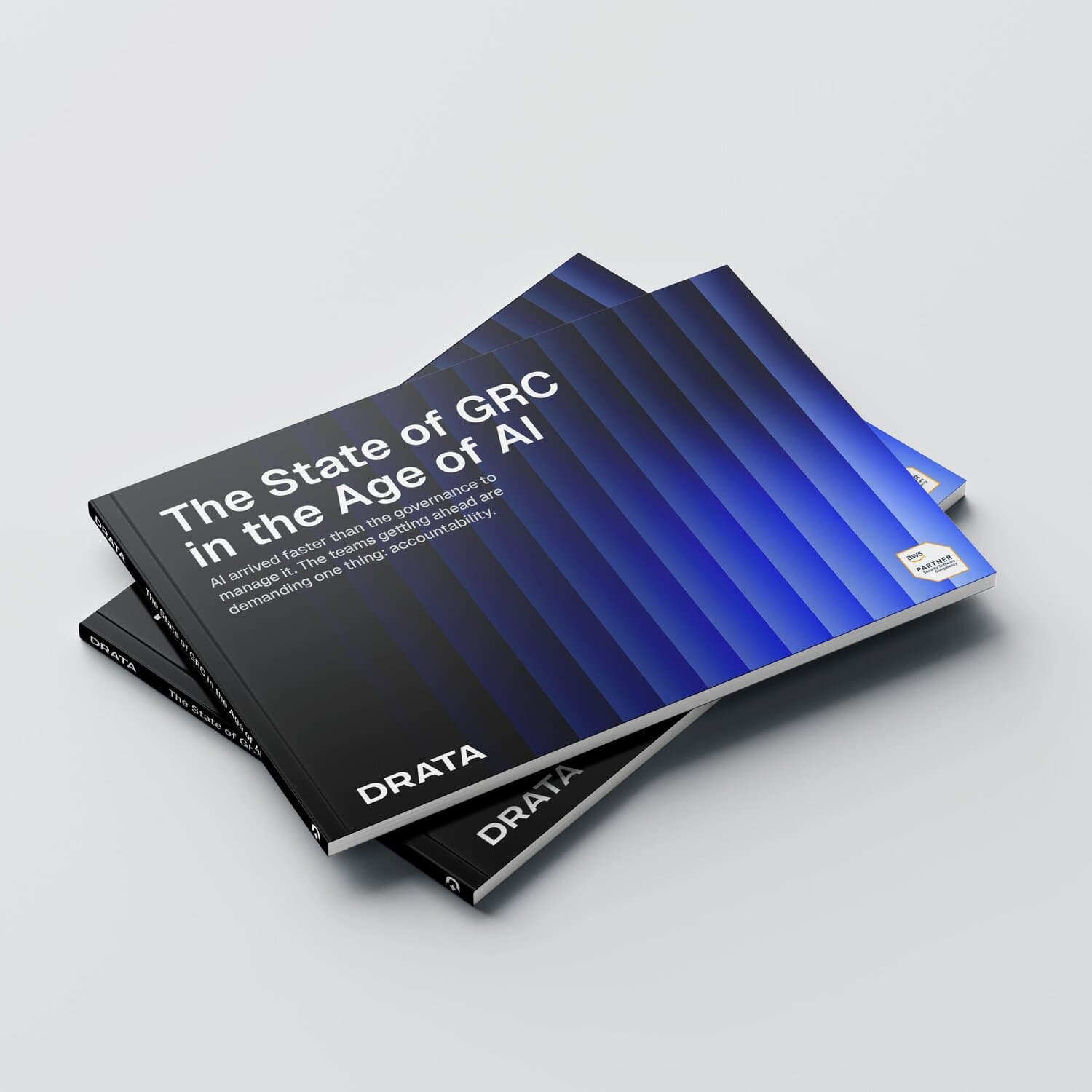
The State of GRC in the Age of AI
Only 13% of IT and security professionals are fully confident they can see every AI tool their teams use. Download The State of GRC in the Age of AI to see what 300 practitioners revealed about governing AI faster than it's outpacing them.
Why Organizations Need GRC Platforms
The pressure to demonstrate trust isn't increasing slowly—it's compounding. Several forces are accelerating demand for integrated GRC risk solutions—a market projected to reach $203.65 billion by 2033.
Regulatory complexity is expanding faster than manual processes can keep up—85% of executives report that compliance requirements have become more complex in just the last three years. New obligations from regulations like DORA (the EU's Digital Operational Resilience Act, a mandatory regulation for financial entities) and the EU AI Act, alongside established frameworks like NIST AI Risk Management Framework (RMF), are layering on top of existing requirements. Organizations managing multiple frameworks across multiple regions need a system that scales—not a spreadsheet that breaks.
Third-party risk is a growing exposure point. Most organizations depend on dozens, sometimes hundreds, of vendors. Each one represents a potential vulnerability—35.5% of all breaches in 2024 were third-party related. Without structured assessment workflows and continuous monitoring, that risk stays invisible until something goes wrong.
Point-in-time compliance no longer provides adequate coverage. Knowing that your controls were effective during last quarter's audit doesn't mean they're effective today. Control drift, personnel changes, and infrastructure updates erode your posture between assessments. A strong GRC platform monitors continuously—so you're always audit-ready, not audit-scrambling.
Teams are stretched thin. Compliance teams cover more frameworks, more vendors, and more requirements with the same headcount. Automation isn't a luxury—it's what makes the function sustainable.
Top GRC Platforms and Risk Solutions to Consider
The market for GRC platforms has matured significantly. The options below represent a cross-section of solutions with different strengths, price points, and target use cases.
Drata
Drata is the Agentic Trust Management Platform built for organizations that need continuous compliance, integrated risk management, and real-time assurance. The platform unifies governance, risk, compliance, and assurance in one place, with automation at its core.
Drata's agentic AI capabilities eliminate the manual work that consumes most compliance teams' time. Evidence collection, questionnaire responses, vendor assessments, and control testing all run continuously and automatically. The platform supports more than 100 frameworks—including SOC 2, ISO 27001, HIPAA, PCI DSS, NIST CSF, GDPR, DORA, and many more—with mapped controls that reduce duplication across audits.
Third-Party Risk Management is fully integrated, not a separate module. Security and compliance teams assess vendors, track risk signals, and monitor posture across their entire vendor ecosystem from a single view. Drata's Trust Center lets organizations share their compliance posture with customers, partners, and auditors in real time—turning security assurance from a friction point into a business enabler.
For growing organizations that need enterprise-grade GRC infrastructure with faster time-to-value, Drata delivers continuous trust, enterprise-grade flexibility, and agentic AI productivity across every dimension of the platform.
Best for: Scaling companies and enterprises seeking an AI-native, fully integrated GRC platform with continuous monitoring across compliance, risk, and assurance.
MetricStream
MetricStream is an enterprise GRC platform with deep roots in risk management and compliance. It offers a connected GRC model that links risk data across business units, enabling organizations to surface cross-functional risk patterns and take coordinated action. The platform is particularly strong in regulated industries and large enterprises with complex governance requirements.
Best for: Large enterprises with mature GRC programs that need robust risk intelligence and analyst-recognized capabilities.
AuditBoard
AuditBoard focuses on audit management, risk, and compliance with a user-friendly interface that appeals to internal audit teams. It has strong cross-functional risk visibility and a connected reporting layer that makes it easier for audit committees and executives to track program performance.
Best for: Internal audit teams and risk managers looking for accessible, collaborative GRC workflows.
LogicGate
LogicGate offers a highly configurable GRC platform built on a no-code workflow engine. It lets compliance teams design custom risk programs, assessment processes, and reporting structures without relying on IT or professional services. That flexibility is a significant advantage for organizations with unique or evolving GRC requirements.
Best for: Organizations with non-standard GRC workflows that need flexibility over out-of-the-box frameworks.
ServiceNow GRC
ServiceNow integrates GRC capabilities directly into its broader IT service management (ITSM) ecosystem. For organizations already running ServiceNow for IT operations, adding GRC creates a unified operational view that connects IT risk to business risk without requiring a separate platform.
Best for: Enterprises deeply integrated into the ServiceNow ecosystem that want unified IT and GRC workflows.
Vanta
Vanta entered the market focused on automating SOC 2 and ISO 27001 compliance for growing technology companies. It has expanded to support more frameworks and added vendor risk capabilities, while maintaining a relatively streamlined implementation experience compared to legacy GRC tools.
Best for: Startups and mid-sized technology companies pursuing their first or second compliance framework.
Archer
RSA Archer is one of the most established enterprise GRC platforms on the market. It offers deep configurability and a broad feature set across risk management, compliance, audit, and third-party risk. It is most commonly deployed at large enterprises with significant IT and professional services resources.
Best for: Large enterprises with dedicated GRC programs and the technical resources to support customization.
OneTrust
OneTrust has strong roots in privacy compliance—particularly GDPR—and has expanded into a broader GRC and trust platform. Its privacy management capabilities are among the most robust available, making it a natural fit for organizations where data privacy is a primary compliance driver.
Best for: Organizations where privacy compliance (GDPR, CCPA, and similar regulations) is a primary use case alongside broader GRC needs.
Workiva
Workiva is known for financial reporting and regulatory compliance, particularly for public companies managing SOX IT General Controls (ITGC) and ESG reporting. It provides strong collaboration, audit trails, and documentation capabilities for compliance processes that intersect with financial reporting.
Best for: U.S. public companies and organizations with significant financial compliance and reporting obligations.
Hyperproof
Hyperproof takes a compliance operations approach, with strong multi-framework support and collaboration features. It is designed to help compliance teams work more efficiently across frameworks by centralizing evidence collection and mapping controls across requirements.
Best for: Compliance-focused teams managing multiple overlapping frameworks who need strong evidence management.
Diligent One Platform
Diligent serves board-level governance, audit management, and risk functions. Its platform connects directors, audit committees, and senior leadership with the compliance and risk data they need to make informed decisions—making it a strong choice for organizations that need governance capabilities at the executive and board level.
Best for: Organizations prioritizing board governance, executive reporting, and audit committee workflows.
IBM OpenPages
IBM OpenPages is an enterprise GRC platform with strong risk quantification, financial risk integration, and regulatory content capabilities. It is well-suited for highly regulated industries like financial services that need sophisticated risk modeling alongside compliance management.
Best for: Large enterprises in heavily regulated industries—particularly financial services—with complex risk quantification requirements.
Essential GRC Platform Capabilities and Requirements
Not all GRC risk solutions are built the same. When evaluating platforms, these are the capabilities that matter most.
Compliance Automation and Multi-Framework Support
The best GRC platforms automate evidence collection, map controls across frameworks, and reduce the manual burden of audit preparation. Look for platforms that support the specific frameworks your organization requires—SOC 2, ISO 27001, HIPAA, PCI DSS, NIST CSF, GDPR, DORA—and that can scale as new requirements emerge. Pre-mapped controls that work across multiple frameworks eliminate duplicated effort across audits.
Risk Assessment and Continuous Monitoring
Point-in-time risk assessments give you a snapshot. Continuous monitoring gives you operational awareness. Look for platforms that monitor controls automatically, flag deviations in real time, and give your team a current view of risk posture—not a view that's accurate only as of the last audit.
Third-Party Risk Management
Vendor risk is one of the most significant and least visible risk categories for most organizations. A strong GRC platform includes built-in Third-Party Risk Management (TPRM) capabilities: structured vendor assessments, risk scoring, response tracking, and monitoring across your vendor ecosystem. Integrated TPRM means you're not managing vendor risk in a separate tool or spreadsheet.
Audit Management and Evidence Collection
Audit preparation shouldn't require a multi-week scramble. Look for platforms that automate evidence collection throughout the year—pulling data directly from integrated systems—so that when an audit begins, your evidence is already organized and current.
Policy and Control Management
Governance depends on policies that are current, owned, and enforced. A good GRC platform centralizes policy management, tracks acknowledgments, monitors control effectiveness, and makes it easy to update policies as regulations change. Version control and approval workflows are essential for regulated environments.
Integrations and API Connectivity
Your GRC platform needs to connect to the tools your organization actually uses—cloud infrastructure, identity providers, development platforms, HR systems, and more. Broad integration libraries and open APIs reduce manual evidence collection and ensure that your compliance posture reflects your actual environment.
AI-Powered Automation
AI is becoming a baseline expectation in modern GRC platforms. Look for platforms that use AI to automate evidence mapping, generate questionnaire responses, surface risk signals, and reduce the manual work that consumes compliance teams' time. Truly AI-native platforms build automation into core workflows—not just surface-level features.
Reporting and Real-Time Dashboards
Compliance status shouldn't be a mystery between audits. Strong GRC platforms provide real-time dashboards for security and compliance teams, executive summaries for leadership, and audit-ready reports for external reviewers. The ability to demonstrate your risk posture in real time—not just at audit time—is increasingly a competitive requirement.
How to Select the Best GRC Platform for Your Organization
Choosing a GRC platform is a significant decision. These steps will help you structure the evaluation process.
1. Define Your Compliance and Risk Requirements
Start with what you actually need to manage. Which frameworks are you subject to today? Which are likely to be added in the next 12–24 months? What are your current gaps—evidence collection, vendor assessment, policy management, or something else? Answering these questions before evaluating vendors prevents you from selecting a platform that solves yesterday's problem.
2. Assess Integration Needs
Identify the tools and systems your GRC platform will need to connect to. Cloud providers, identity platforms, ticketing systems, HR tools, and endpoint management are common integration points. A platform with strong native integrations reduces manual evidence work and keeps your compliance posture current automatically.
3. Evaluate Scalability and Framework Coverage
Your GRC requirements will grow. Select a platform that supports the frameworks you need today and the ones you're likely to add. Also evaluate how the platform scales as your organization grows—in headcount, in geographic footprint, and in the complexity of your vendor ecosystem.
4. Review Analyst Recognition and Gartner Magic Quadrant Rankings
Third-party analyst coverage provides useful validation for enterprise platform decisions. Gartner's Magic Quadrant for Integrated Risk Management evaluates vendors across completeness of vision and ability to execute. Platforms recognized by Gartner and Forrester have typically been evaluated against a rigorous set of criteria and customer evidence. Use analyst recognition as one input—not the only input—in your evaluation.
5. Request Demos and Pilot Programs
There is no substitute for hands-on evaluation. Request demos tailored to your specific use cases, not generic product tours. Where possible, negotiate a pilot program or proof of concept with realistic data. The platforms that look best in demos don't always perform best in practice—direct evaluation closes that gap.
Common GRC Implementation Challenges
Even the best platform won't succeed without a clear implementation plan. These are the challenges that most commonly create friction.
Integration with Existing Systems
Connecting a GRC platform to legacy infrastructure, on-premises systems, or custom-built tools takes more time than most teams expect. Build integration requirements into your vendor evaluation early, and ask specifically how each platform handles systems that don't have native connectors.
Organizational Change Management
GRC platforms change how compliance, security, and risk teams do their work. Without deliberate change management—clear communication, training, and executive sponsorship—adoption suffers. The technology is only part of the implementation challenge.
Resource and Budget Constraints
Most GRC implementations are led by small teams managing competing priorities. Underestimating the internal resource commitment—for initial configuration, data migration, and ongoing administration—is one of the most common reasons implementations stall. Build resource requirements into your business case before selecting a vendor.
Evolving Regulatory Requirements
Regulatory frameworks change. New requirements emerge. What you implement today may need to expand within 12 months. Choose a platform with a track record of keeping its framework library current, adding new frameworks on a reasonable timeline, and providing guidance as regulations evolve.
How GRC Platforms Enable Continuous Risk Management
Traditional GRC approaches are built around the audit cycle—prepare, audit, remediate, repeat. That cadence works when the world moves slowly. It doesn't work when controls drift between assessments, regulations take effect mid-year, and vendors introduce risk without warning.
Continuous risk management treats compliance as an operational state rather than a periodic event. Controls are monitored automatically. Risk signals surface in real time. Evidence accumulates throughout the year. When an audit begins, you're demonstrating a posture you've maintained all along—not assembling one from scratch.
This shift has meaningful business implications. Security reviews move faster when your trust documentation is always current. Partnership decisions accelerate when risk posture is easy to share. Compliance teams spend less time on reactive work and more time on strategic risk management.
The frameworks your organization manages—SOC 2, ISO 27001, HIPAA, DORA, NIST CSF, and others—are designed to reflect your real security posture. Continuous monitoring is what makes that reflection accurate.
Build Trust and Reduce Risk with the Right GRC Solution
GRC risk solutions have moved from nice-to-have to operationally essential. The organizations that manage compliance and risk most effectively aren't doing it manually—they're doing it with platforms built for continuous monitoring, AI-powered automation, and integrated risk management across every dimension of the business.
The right GRC platform doesn't just help you pass audits. It helps you maintain a security and compliance posture that earns trust with customers, partners, and regulators—every day, not just during audit season.
Drata supports continuous compliance across more than 100 frameworks—from SOC 2 and ISO 27001 to HIPAA, GDPR, DORA, and beyond.
FAQs about GRC Risk Solutions
Is GRC still in demand?
Yes—and demand is accelerating. Expanding regulatory requirements (including DORA, GDPR, the EU AI Act, and state-level privacy laws), the growth of AI-driven operations, and increasing vendor ecosystem complexity are all driving organizations to invest in formal GRC programs. The Gartner Integrated Risk Management market continues to grow as organizations replace fragmented, manual processes with unified platforms.
What Is the difference between GRC and Integrated Risk Management?
Governance, risk, and compliance (GRC) is the broader discipline; Integrated Risk Management (IRM) is a specific approach within it. IRM emphasizes breaking down silos between IT risk, operational risk, third-party risk, and compliance—connecting risk data across the organization to enable coordinated decision-making. Many modern GRC platforms are built around IRM principles, treating risk as a connected, organization-wide signal rather than a series of isolated assessments.
How much do GRC platforms typically cost?
Pricing varies widely based on organization size, feature set, and contract structure. Many platforms use per-user or per-module pricing models. Smaller organizations focused on a single framework may find entry-level options in the range of a few thousand dollars annually. Enterprise platforms with full risk management, TPRM, and multi-framework support typically run significantly higher. Total cost of ownership should include implementation services, integration work, and ongoing administration—not just licensing fees.
How long does GRC implementation take?
Implementation timelines range from a few weeks for streamlined platforms to several months for large-scale enterprise deployments. Factors that affect timeline include the number of integrations required, the complexity of existing control environments, the number of frameworks being mapped, and the availability of internal resources. Platforms with strong professional services support and pre-built integrations typically have faster time-to-value.
Can GRC tools replace manual compliance processes entirely?
GRC platforms automate a significant portion of manual compliance work—evidence collection, control testing, policy acknowledgment tracking, vendor assessments, and audit preparation. They don't eliminate human judgment entirely; risk decisions, control ownership, and regulatory interpretation still require expert review. The goal is to remove repetitive, low-value manual work so compliance teams can focus on higher-order risk management and strategic decision-making.