
We’re living through one of the most pivotal shifts the trust and security world has seen in decades—a moment where AI is no longer a tool operating on the edges of our workflows, but a force reshaping the very foundations of how organizations earn and maintain trust.
Every leader I speak with, across every industry, is feeling it.
AI is accelerating innovation, but it’s also exposing gaps in the systems, processes, and assumptions that guided us for years. The pace of change is no longer linear. It’s compounding.
And with that acceleration comes a simple truth: the future of compliance, security, and assurance will belong to the organizations that can pair AI-driven velocity with uncompromising integrity. This is the transformation already underway—one that calls on all of us to rethink how trust is built, measured, and scaled.
This is the theme we explored across San Francisco, New York, and London during the Drataverse City Tour 2025, and as we move into the new year, it becomes even more true: the future of trust is transparent, continuous, and autonomous.
AI Is Rewriting the Business Operating System
Over the past year, I’ve had countless conversations with CISOs, auditors, founders, and security leaders who are sitting at the front edge of AI adoption. Whether they’re building, buying, or evaluating AI technologies, they all describe a similar experience: acceleration unlike anything we’ve seen before.
Workflows are being reimagined overnight. Teams are testing new capabilities weekly. Entire categories of risk are emerging in real time. It’s exciting — and it’s daunting.
But the most important shift isn’t the rapid innovation itself. It’s what the innovation is exposing.
Trust can no longer be assumed. It has to be demonstrated—continuously, transparently, and with a level of precision only automation can provide.
I spend much of my time speaking with customers and security leaders about the problems they’re trying to solve, and AI was at the crux of nearly every conversation over the last year. In fact, one Fortune 500 CISO put it plainly when they told me:
“Our CFO gave us a nearly blank check to adopt AI immediately because the risk of not adopting it is now greater than the risk of moving too fast.”
And while this is a great sentiment, leaders everywhere are facing this same tension: AI is unlocking enormous opportunity, but it’s also exposing an equally enormous gap in how organizations keep and prove trust.
From those conversations, three themes come up again and again:
- Vendor risk is exploding. Security teams can’t assess AI vendors as fast as they’re being implemented.
- Audit overhead is growing. More frameworks, more evidence, more controls — all multiplied by AI.
- Assurance expectations are rising. Customers want real-time visibility into how their partners are using AI.
AI isn’t just adding complexity, it’s redefining the trust requirements for doing business. And it’s clear the old manual operating system for compliance can’t support this new world.
A New Trust Operating System is Required
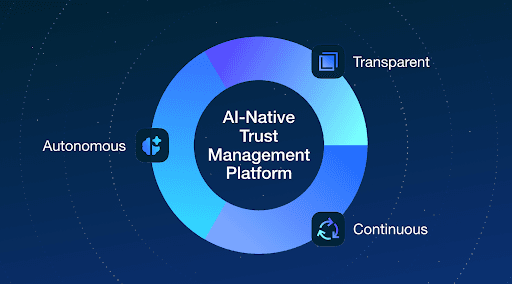
Here at Drata, we believe a different foundation is needed—one built for the speed and scale of AI. At Drata, we call this the New Trust Operating System, built on three core principles that require it to be:
- Transparent. Every policy, control, test, and piece of evidence is traceable from end to end. Not hidden in spreadsheets or static documents, but visible, verifiable, and always up to date.
- Continuous. Audit readiness is no longer a seasonal activity. It becomes a persistent state—a reflection of your real-time trust posture.
- Autonomous. Manual processes driven by humans can no longer keep up with the pace of business. As AI agents begin to interact with data, systems, and each other, they must be able to validate and preserve trust without human intervention.
At its core, the idea of Trust Management has historically been the process of ensuring that a company is secure, compliant, and worthy of customer trust. But that definition has evolved and it’s been reshaped by the market.
Now, Trust Management has become the continuous process of not just ensuring but also communicating that a company is secure, compliant, and worthy of customer trust. In other words, it’s taking all of the hard work that security and GRC teams are doing, from identifying risk, implementing controls, enforcing policies, monitoring vendors, passing audits…and communicating all of that in a clear and concise way externally for auditors, customers, and really the world to consume.
As we move into 2026 and evolve the definition, it’s important to note that we’re not just renaming GRC to Trust Management. We’re reframing GRC to include Assurance, moving from GRC to GRC+A— where governance, risk, compliance, and assurance don’t operate in silos, but come together as a unified, automated trust layer supporting the entire business.
Building the First Full-Stack Trust Management Platform
This is the foundation the next decade of business will be built on. And here at Drata, our acquisition of SafeBase marks an important step forward in making this foundation real as we solve two halves of the same problem:
- The core Drata product ensures trust internally through continuous monitoring, automation, and governance.
- Meanwhile, the SafeBase Trust Center communicates trust externally—giving customers, auditors, and partners real-time visibility into that posture.
Bringing those capabilities together created something the industry hasn’t seen before in a full-stack Trust Management platform. From compliance automation to risk management to live assurance, organizations can now:
- Reduce the friction of customer security reviews
- Share real-time, verifiable trust signals
- Replace static PDFs and questionnaires with dynamic transparency
- Build trust networks that scale as they grow
This isn’t just an upgrade to how companies manage compliance. It’s a shift in how companies build and maintain trusted relationships in the AI era, and Drata is proud to be leading the charge.
Looking Ahead: Trust at the Speed of AI
When we founded Drata four and a half years ago, we had a bold vision: to become the trust layer between great companies. Today, with over 8,000 customers, 134 million assets monitored, and 161 million automated tests running continuously, that vision is becoming a lived reality. And not because of the numbers themselves, but because of what they represent: a community that believes transparency, automation, and security are not optional but essential.
Our three Drataverse City Tour stops reaffirmed something I’ve always believed: the future of trust isn’t being built by any single company. It’s being built by a community made up of security leaders, auditors, innovators, partners, and pioneers who see the same inflection point on the horizon. If you’re reading this, you’re part of that community.
Whether you’ve been with Drata from the beginning or are just starting to explore what continuous, autonomous trust could mean for your business, I want you to know this: we’re building the future of trust with you, not just for you.
Your challenges shape our roadmap. Your ambition fuels our innovation. Your trust makes everything possible.
And as we look ahead, one thing is clear: the best chapters are still in front of us, and the future of trust is coming faster than any of us imagined. I’m so excited to show you what’s next.
Discover the power of the continuous, transparent, autonomous Trust Management Platform. Book a demo today to get started on building trust on your terms.